
Teaching You to Roller Skate
After graduating from railway college, I went to work at a railway station. That same year, a young woman joined the station as well. She had graduated from the Railway Transportation School and was a few years younger than I was.
She was an exceptionally talented woman—graceful, energetic, and good at just about everything. She could sing and dance, played several musical instruments, and excelled at all kinds of sports. At school, she had even served as head of the Student Union's Arts and Culture Department. She was the sort of person who seemed to shine wherever she went, which probably helped her land a position at such a competitive railway station.
She liked me. I, however, had absolutely no idea.
I didn't figure it out until one particular incident.
One day, she asked me if I knew how to roller-skate.
I've never been much of an athlete, and my coordination has always been a disaster, so I told her honestly that I'd never skated before.
"I'll teach you this weekend," she said. "There's a rink by QingShui River Bridge. It's really easy."
I'd only recently started working at the station, and my weekends were still relatively free. I had always been intrigued by the people who whizzed around the rink with effortless grace. Maybe, I thought, once I learned, I could look that cool too.
So I agreed.
She said it was easy.
It wasn't.
For someone as hopeless on skates as I was, learning to roller-skate was practically an act of self-endangerment. I could barely stand, let alone move. She, on the other hand, was an excellent skater. She glided around the rink twice with such effortless grace that people couldn't help watching her.
Then she came over to me and began my first lesson.
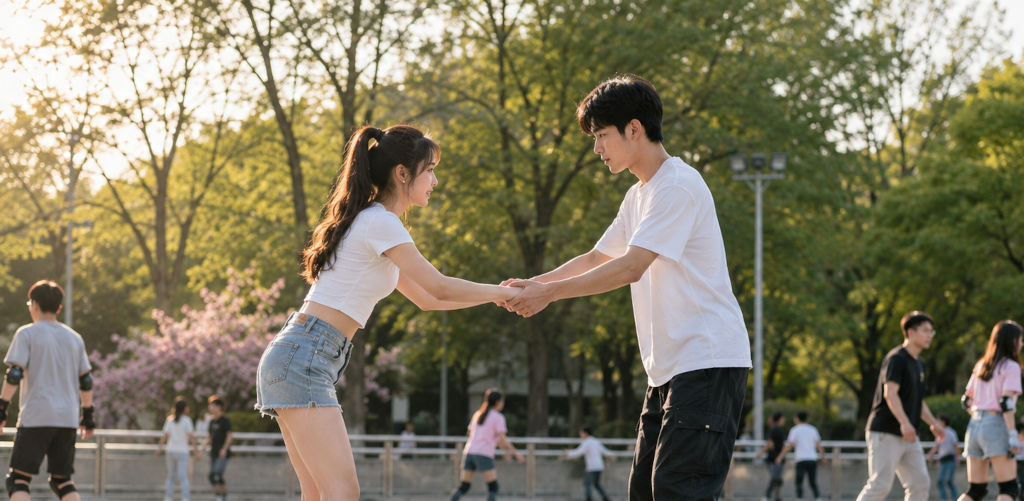
She was incredibly patient. Holding my hand, she guided me slowly, step by step, explaining the basics as we went. I followed her instructions with extreme caution.
And promptly fell.
From that moment on, I felt as though I were standing on the edge of a cliff—or walking on thin ice. There was no way I was letting go of her hand again.
She, meanwhile, seemed delighted. She had no intention of letting go of my hand either, and she continued teaching me with great enthusiasm.
I was so nervous that I had no attention to spare for anything else. Several times, just as I was about to fall, I grabbed hold of her as desperately as if she were a lifeline.
I barely dared look at her. I was far too embarrassed, especially with so many people around.
Eventually, after a great deal of trembling and stumbling, I managed to move forward on my own.
She praised me enthusiastically.
"You're a fast learner," she said. "It's rare to do this well on your first try."
That was the first—and, as it turned out, the only—time in my life that I ever roller-skated.
It was also the first time I had ever held a girl's hand while skating, and occasionally even ended up in her arms.
And it remains the only time I have ever roller-skated to this day.
By then, even I finally understood what had been going on all along.
She had liked me.
We didn't end up together.
Not long afterward, I was transferred from the station to the personnel department of the railway bureau. The next time I saw her was several years later, at an English proficiency examination for professional-title evaluations within the railway system.
She was there as a candidate.
I was there as an invigilator.
The moment I saw her, I realized she had already noticed me. She was looking straight at me with a smile. She had recognized me long before I recognized her.
By then, she was heavily pregnant and soon to become a mother.
We exchanged a brief greeting. Then the exam papers were handed out, and the test began.
As I walked around the examination room, I noticed her biting the end of her pen, frowning at one of the questions. She was clearly stuck.
I walked over.
She looked up at me.
I gave her a discreet wink.
She understood immediately.
With her pen, she casually tapped a few spots on the exam paper. I memorized the questions, returned to the podium, and began to "review" the exam papers with great concentration.
The questions were roughly at the level of a freshman or sophomore college course—nowhere near as difficult as CET-4. I worked out the answers, scribbled them onto a tiny piece of paper, and tucked it away.
Then I resumed my rounds.
When I reached her desk again, her pen "accidentally" fell right beside my foot.
She started to bend down to pick it up, but I quickly gestured for her to stop. Given her condition, she shouldn't be bending over unnecessarily.
So I picked up the pen for her—and, along with it, discreetly passed her the little note.
Compared with our first collaboration on the roller-skating rink, our teamwork this time was remarkably smooth.
When the exam ended, there was still plenty to do: collecting the papers, counting them, sealing the envelopes, and so on. We had only enough time for a hurried goodbye.
I didn't know then that it would be the last time we ever saw each other.
Before I eventually left the railway system, I asked some mutual acquaintances about her. I learned that she had gone on to become the Communist Youth League secretary at a major railway station—a respectable management position.
I hope life has treated her well.
These days, there's a saying among young people:
"If you want to win a woman's heart, take her hiking."
The idea, of course, is to create opportunities for physical closeness.
But perhaps the younger generation still has something to learn from us old-timers:
"If you want to win a woman's heart, take her roller-skating."
The roller rink has long since disappeared.
But sometimes, even after all these years, I can still remember the feeling of that hand holding mine.